

Emblematic Birds
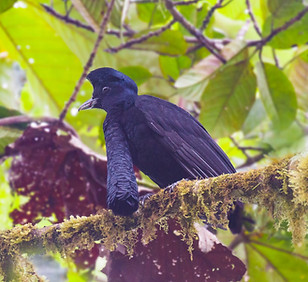
This bird inhabits the tropical forests of Ecuador and Colombia, where its distinctive morphological and acoustic adaptations are believed to play crucial roles in communication and reproductive success. The male exhibits a prominent throat protuberance that undergoes a marked expansion during vocalization, increasing several times in size until it assumes a form reminiscent of a tie. This expansion is not merely a visual signal; it is coupled with a unique call—remarkably similar to the sound of blowing into an empty bottle—that propagates over several kilometers. Such acoustic signaling is likely instrumental in territory defense and mate attraction in these dense forest environments, warranting further investigation into its evolutionary significance and ecological impact.
Other names:
Langlappen-Schirmvogel,
Paragüero Corbatudo,
Uccello parasole caruncolato,
ナガエカサドリ,
Anambé-papudo,
Эквадорская зонтичная птица,
长耳垂伞鸟

This avian species, distributed across the Asian continent from India to Sri Lanka—specifically within the Western Ghats—exhibits a unique reproductive strategy aimed at enhancing the survival of its offspring. The species protects its mate and progeny by confining them within a naturally occurring tree cavity. Notably, only a narrow aperture is maintained, through which the adult can supply nourishment throughout the ensuing months of the breeding season. This nest-confinement behavior likely serves to minimize the risk of predation and environmental hazards while ensuring a controlled and secure feeding pathway for the developing young.
Other names :
Malabarhornvogel,
Cálao Coronado,
カササギサイチョウ
Индийская птица-носорог
calau-alvinegro
印度冠斑犀鸟

This widely distributed bird inhabits regions from Venezuela to Bolivia, exhibiting a striking coloration that ranges from scarlet red to bright orange.
During reproduction, females assume the primary role of decision-making by selecting the most exemplary male, one endowed with traits such as proficient dancing, brilliant coloration, and impeccable plumage. It is documented that some males never reproduce due to the exacting standards imposed by the females.
Other names:
Andenfelsenhahn,
Gallito de las Rocas Peruano,
Galletto di roccia delle Ande,
アンデスイワドリ,
Андский скальный петушок,
安第斯冠伞鸟
Marvelous Spatuletail

The Marvelous Spatuletail is one of the most extraordinary hummingbirds in the world and is endemic to northern Peru. The male is instantly recognizable by its iridescent emerald crown, brilliant turquoise-blue throat, and two extremely long outer tail feathers that end in rounded, violet-blue spatula-shaped discs. These remarkable tail streamers are used in elaborate courtship displays and can be several times the length of the bird’s body. The female lacks the spatulate tail and is more subtly colored, with green upperparts and pale underparts marked with light spotting.
Some observers have noted that this movement resembles the flight pattern of certain butterflies found in the same Andean cloud forest habitat. By spreading and oscillating his tail ornaments, the male may visually mimic the fluttering motion of a butterfly, blending the movement with the surrounding environment and vegetation. This visual illusion enhances the dramatic effect of the display, making it highly conspicuous to females while still harmonizing with the natural background.
Although the display strongly resembles butterfly flight, it is primarily a sexual selection strategy rather than true mimicry for camouflage. The exaggerated tail and coordinated aerial movements evolved to attract females, making the Marvelous Spatuletail one of the most extraordinary examples of ornamental evolution among hummingbirds.
Other names
spatelstjärt
Colibrí Admirable
изумительный ракетохвост-лоддигезия
オナガラケットハチドリ
Beija-flor-sílfide
叉扇尾蜂鸟